

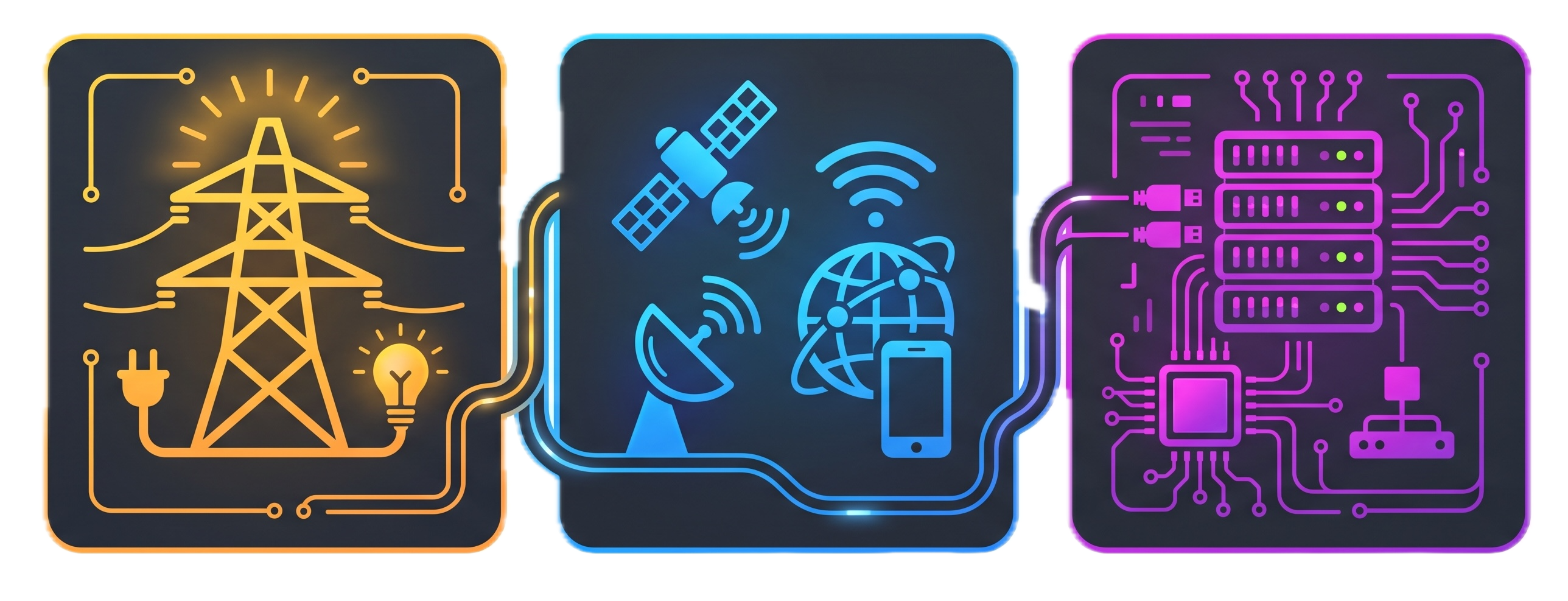
Four years into the generative AI boom, we experience an immense, debt-fueled infrastructure push. Some argue that including planned data-centers, we might surpass the total compute capacity of all human brains combined. While I strongly advocate against comparing chips with human brains (which are by far more than calculators, more a social organ and its complexity and capabilities by far exceeds any existing computational systems), without doubt, we experience an area of unprecedented compute capabilities, which I coined computational fabric in 2025. This shift is enabled by the previous build-out of digital infrastructure, energy (grids, decentralized generation and storage) and communication (cable, wireless, satellite infrastructure).
In the US alone, BEA data shows investment in software increased significant to over 11% year-over-year. As Marcello Estevão notes in his IMF research, global datacenter build-outs may require an eye-watering $6.7 trillion in capital expenditure by 2030.
Yet, when you look closely at macro productivity, the needle has barely moved. Even when comparing high-adoption tech hubs like California to lower-adoption regions, there is no statistically significant productivity divergence. The existing gap is explained by capital investment, not an “intelligence advantage.”
Why is unprecedented compute failing to move the macro needle?
The Lesson from Pre-1931 Intelligence
A few weeks ago, I was reading into research around time-capsuled AI models, most notably Talkie, a 13-billion parameter model trained strictly on pre-1931 public domain texts from Harvard libraries.
When researchers tested this time-capsuled model, two contrasting behaviors emerged:
Emergent Abstraction: Prompt Talkie with snippets of Python code, and it writes syntactically coherent, working code - despite being trained on books printed decades before electronic computers existed. It abstracted structural logic, grammar, and systemic relationships from pure language.
Contextual Collapse: Ask Talkie to forecast the Great Depression, predict World War II, or navigate modern social shifts, and its predictive ability vanishes. It defaults directly to the factual blind spots and social norms of 1920s literature (= training data).
If LLMs possessed intrinsic, general reasoning capabilities, a model holding a comprehensive dataset of 1920s economic and geopolitical literature would be able to deduce immediate trajectory shifts. Instead, Talkie proves what LLMs actually are: structural compressors of training data, not dynamic reasoning engines.
An LLM doesn't “know” what is true or what will happen next; it only predicts the next statistically plausible tokens based on where its training boundary was drawn.
Is AI Really Intelligence?
The research on time-capsuled AI forces us to think about two questions:
Is what we call AI really intelligence? In my view, true intelligence expresses itself by being in active resonance with its environment - changing the world around it and constantly modifying itself in response. Current AI does neither. It cannot manipulate physical or organizational reality at scale, nor can it dynamically re-design its own hardware or structure. What we see today is very capable computational throughput - a massive computational fabric - but fabric is not agency.
Is raw intelligence correlated with productivity? In business, strategy and analysis have rarely been the main bottlenecks. Thinking about strategy consultants, the hardest part never was coming up with great analytical research and recommendations, but to overcome political friction, regulatory constraints, execution, to convince people and to align an organization.
Assuming every company has cheap and continuous access to top-strategy consulting analysis, this changes very little if the operational bottleneck was actually execution.
The Accounting Paradox and the Debt Wall
Economists argue that GDP is a lagging indicator and our accounting systems fail to measure intangible assets like clean datasets or model weights. There is also a delay between a tool or capability becoming available and its productive use by people and organizations.
However, there is another challenge. We are borrowing from the future (debt) to build massive infrastructure today, assuming that scaling compute capabilities will eventually deliver productivity. However, research is indicating that scale in processing actually is not the real bottleneck anymore. More compute might further improve compression efficiency, but a better and faster “calculator” for human text and knowledge cannot solve an execution problem. If this bet is not playing off, expectations will need to reset and lender will loose their investment.
Positioning in an Area of Huge Expectations
To build defensible, lasting software businesses in times when expectations are huge, money is cheap and immense sums are invested into enabling infrastructure, the playbook must shift:
Separate story from reality. Understand the potentials and limitations of current infrastructure, models and software. In many areas the capabilities of AI systems are vastly exaggerated, humanised and distorted by marketing that aims to raise more funds and sell products. However, likewise many capabilities are not fully understood or not yet applied in an efficient and value generating way. Separating the wheat from the chaff remains a challenge, for users, buyers and investors alike.
Determine where the real value is created. Is it the hardware infrastructure, the data, the models, the distribution? Likely a good place to look is, where real-world workflows are automated and augmented or new possibilities are created that have not been possible before.
Identify the defensible moat. Long term differentiation likely is not rooted in model size, code, algorithms or sheer amount of data. Public available data is becoming toxic due to AI generated junk, leading to a “degeneration to the mean” for models trained on it. Clean, human-generated and validated data loops that are embedded into operational workflows are value drivers.
Building a sustainable business has never been about riding the hype or chasing after expectations, but about separating the signal from the noise, understanding the customer and using the best and most affordable technology to create value.
While we might not end up with artificial intelligence or AGI anytime soon, we might have something even more valuable at hand: cheap and more capable compute infrastructure that can better help us crack hard problems or just automate tasks we should not waste our energy and resources on or that are just too cumbersome to execute.