

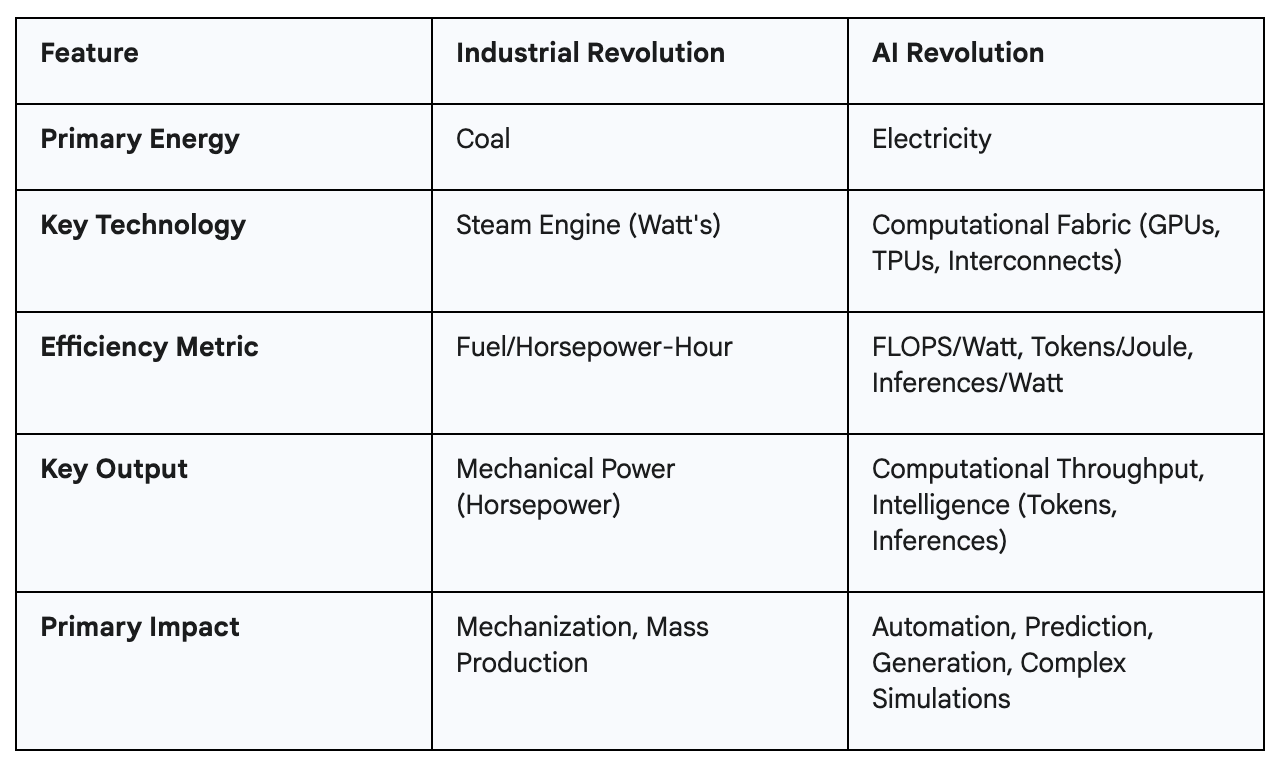
History often rhymes. The Industrial Revolution, kicking off in the 18th century, fundamentally reshaped our world, moving us from farms and workshops to factories and mass production. Today, we’re living through another seismic shift: the AI Revolution. Like steam power before it, AI promises radical transformation across every sector, boosting efficiency, productivity, and potentially, our quality of life.
But what really fuels these revolutions? It’s not just about finding new energy sources – coal then, electricity now. The true catalyst is the dramatic leap in useful output and capability we get for each unit of energy spent. Think “Output per Watt.” While efficiency gains are important, the game-changer is unlocking significantly more capability, enabling the previously impossible.
In the AI era, this engine is the computational fabric – the intricate weave of processors (CPUs, GPUs, TPUs), memory, storage, software, and the high-speed interconnects binding them. Maximizing the intelligence generated per watt within this fabric is key to pushing the AI revolution forward. Let’s explore why this metric has always been, and remains, the core engine of progress.
1. Output per Watt: The Unchanging Engine of Progress
The common story focuses on energy efficiency (doing the same with less). But the real driver is efficiency (doing more with the same).
Why It Matters:
Industrial Revolution: James Watt’s steam engine wasn’t just about saving coal; its vastly improved power output per unit of fuel enabled factories anywhere and powered new forms of transport. Capability per lump of coal was key.
AI Revolution: The goal isn’t just cutting electricity bills. It’s leveraging escalating computational capability per watt (FLOPS/watt, Tokens/Joule) to build bigger models, run complex simulations, and create entirely new AI applications.
The Core Idea: Progress hinges on expanding what’s possible per unit of energy. Efficiency enables this, but capability is the ultimate prize.
The Takeaway: Revolutions aren’t just about saving energy; they’re defined by massive leaps in output and capability per unit of energy consumed.
2. Forging the Industrial Age: Output per Lump of Coal
Pre-industrial economies relied on limited “organic” energy (muscle, wood, wind, water). Britain’s shift to coal, driven partly by wood shortages, unlocked a dense energy source.
The Challenge: Early steam engines (c. 1712) could pump water from coal mines but were incredibly inefficient fuel hogs.
Watt’s Breakthrough: James Watt’s separate condenser (patented 1769) dramatically cut fuel use (~75%).
Capability Unleashed:
More Power, Less Fuel: Delivered significantly more useful mechanical power per unit of coal.
Versatility: Adapted for rotary motion, becoming a universal power source for factories.
Location Freedom: Factories could be built anywhere, not just near rivers.
Transport Revolution: Powered steam locomotives and ships, shrinking distances.
The Impact: This explosion in available power per unit of fuel (1 steam HP ≈ 21 laborers) drove unprecedented industrial and economic growth.
The Takeaway: Watt’s genius wasn’t just efficiency; it was the massive increase in mechanical work output per unit of coal that truly powered the Industrial Revolution.
3. Manufacturing Intelligence: The Rise of AI’s Energy Demand
Today, electricity fuels the AI revolution, and demand is surging. Training large models and running them (inference, the bulk of the energy use) consumes enormous power.
Skyrocketing Demand:
AI compute needs are doubling roughly every 100 days or faster.
Data centers are major consumers, needing power for IT gear, cooling, and networking.
Global data center electricity use could double by 2026-2030, potentially exceeding Japan’s total consumption.
The Engine: This electricity is converted into intelligence by the computational fabric.
The Takeaway: Electricity is the new coal, and AI’s thirst for it is growing exponentially, driven by massive models and constant use (inference).
4. The Computational Fabric: Weaving AI’s Future (and its Energy Needs)
The computational fabric is the integrated system making AI possible – processors, memory, storage, software, and crucially, the interconnects.
Core Components:
Processors: CPUs plus specialized AI accelerators (GPUs like NVIDIA’s H100/Blackwell, Google’s TPUs) handle the heavy lifting of deep learning calculations.
Interconnects: High-speed pathways (Ethernet, InfiniBand, NVLink, CXL, optical, Stelia) are the vital threads moving data between components.
Why Interconnects are Critical:
Bottlenecks Kill Efficiency: Slow data transfer leaves expensive GPUs idle, wasting energy and slashing the system’s effective output per watt. Even tiny network issues (1% packet loss) can cripple performance (by 30%).
Scaling Challenges: Traditional copper interconnects hit limits. Optical interconnects promise higher bandwidth, lower latency, and better power efficiency, especially for large AI clusters.
Measuring AI Output per Watt:
FLOPS/Watt: Raw compute throughput per watt.
Tokens/Second (TPS): Language model processing speed.
Tokens/Joule: Energy efficiency of language processing (lower is better).
Inferences/Watt: Energy cost per task/query (a ChatGPT query might use 10x the power of a Google search).
The Takeaway: It’s not just about the chips. Optimizing the entire computational fabric, especially the data-moving interconnects, is essential for maximizing intelligence per watt.
5. Capability Over Mere Efficiency: Why Output per Watt Reigns Supreme
Like the steam engine era, the AI revolution prioritizes expanding what’s possible per watt, not just cutting costs.
The Drive for More:
The relentless push for larger models and the rapid doubling of compute needs show the focus is on achieving more intelligence per unit of energy.
Microsoft’s Satya Nadella highlights “tokens per dollar per watt” as the key metric, emphasizing output.
Efficiency as an Enabler: Algorithm and hardware improvements make it feasible to pack more capability into a given energy budget, fueling further innovation.
Jevons Paradox in AI: Efficiency gains can make AI cheaper, leading to wider adoption, more demanding applications, and potentially higher total energy use – underscoring that expanding capability is the dominant force.
The Takeaway: Efficiency is vital, but the ultimate goal driving AI (like the Industrial Revolution before it) is the exponential growth in capability achieved per watt.
6. Realizing the Potential: The Fruits of Enhanced Output per Watt
Improving output per watt translates directly into powerful real-world applications.
Virtual Realm Enhancements:
Advanced Simulations: Enables complex modeling in science (climate, drug discovery), engineering, and finance, often hundreds of times faster and more energy-efficient.
Smarter Digital Services: Powers better recommendations, personalized content, real-time translation, and sophisticated virtual assistants.
Immersive Experiences: Crucial for realistic graphics, dynamic environments, and believable AI characters in gaming, training simulations, VR/AR, especially on power-limited devices.
Physical World Transformation:
Scientific Discovery: Accelerates breakthroughs in materials science (new solar cells, batteries), drug discovery, genomics, and physics by analyzing massive datasets.
Smarter Energy Systems: Optimizes grids, improves renewable forecasting, integrates distributed resources, enables predictive maintenance, potentially unlocking huge capacity in existing lines.
Autonomous Systems: Allows more sophisticated perception and faster decision-making on power-constrained vehicles, drones, and robots (Edge AI).
Optimized Logistics & Manufacturing: Enhances supply chains, improves process control (”AI Factories“), enables advanced quality checks, and predictive maintenance.
Healthcare: Improves medical image analysis, aids personalized treatment plans, and speeds up diagnostics.
The Rise of the Edge: Many applications demand low-latency AI on devices with tight power budgets (vehicles, sensors). This intensifies the need to maximize “intelligence per watt” at the edge through model optimization and specialized low-power chips.
The Takeaway: More AI capability per watt isn’t just theoretical; it’s actively creating smarter simulations, better digital services, accelerating science, optimizing industries, and pushing intelligence to edge devices.
Looking Ahead: Powering the Future, Watt by Meaningful Watt
From steam power to the computational fabric, history shows that transformative progress hinges on getting more useful output per unit of energy. The pursuit of more capability per watt – horsepower per lump of coal then, intelligence per joule of electricity now – remains the engine driving revolutions.
Continued innovation across the entire computational fabric (chips, interconnects, algorithms) is essential for sustainably scaling AI. Addressing AI’s energy demands and carbon footprint requires maximizing output per watt alongside strategies like using renewable energy.
The Industrial Revolution amplified muscle power. The AI Revolution amplifies brainpower. By boosting the intelligence generated per watt, we unlock the next wave of innovation, transforming industries and potentially creating a more efficient, sustainable world. This isn’t just engineering; it’s a strategic imperative.