

The viral rise of OpenClaw in early 2026 - gaining over 220k GitHub stars in record time - isn’t just a trend; it’s a shift in how we architect AI. The true innovation lies in its radical minimalist core and its “Skill-based” approach to counter the app economy.
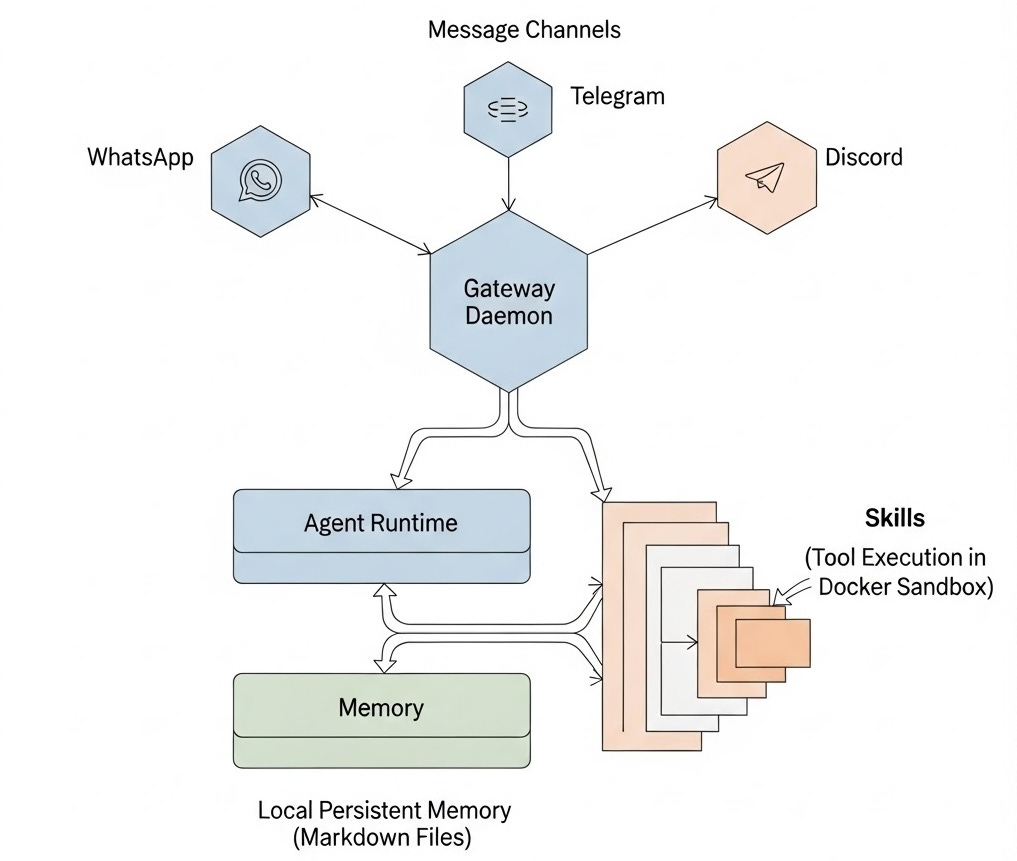
Below are the core learnings and architectural pillars of the OpenClaw ecosystem.
1. The Minimalist Engine: Pi-Mono
At the heart of OpenClaw is Pi (pi-mono1 project by Mario Zechner). Unlike monolithic coding agents that ship with thousands of lines of prompt scaffolding, Pi operates on a philosophy of subtractive design.
The Four Primitives: Pi restricts the agent to just four tools: read, write, edit, and bash.
Context Efficiency: By keeping the system prompt under 1,000 tokens, it leaves more room for the task at hand.
YOLO Mode: It rejects security complexity. By default, Pi runs with direct filesystem access, assuming that if you trust an agent with your data, you must trust it with the execution.
2. The Certainty-Scope Trade-off
OpenClaw provides a live case study for Luciano Floridi’s 2025 Conjecture2, which formalizes the tension between an AI’s reliability and its versatility.
C(M) (Certainty): The provable correctness of the AI’s output. This is defined as 1 minus the worst-case error probability over the input space. A value of 1 represents a formal guarantee of error-free performance.
S(M) (Mapping Scope): The complexity and richness of the input/output domain. This is the joint Kolmogorov complexity of the input and output spaces. It serves as a proxy for the information-theoretic breadth or richness of the domain.
k: constant > 0
The Learning: As OpenClaw scales from a local terminal (Low Scope, High Certainty) to a multi-channel “Gateway Mode” (High Scope), it inevitably accrues debt. You gain the ability to talk to your agent via WhatsApp, but you lose the “log-level” certainty of why it just executed a specific bash command.
3. Skills vs. MCP: Mechanism over Interface
In late 2025, a divide emerged between two ways of giving AI tools: Anthropic’s Model Context Protocol3 (MCP) and the Agent Skills4 standard.
MCP:
Philosophy: Hide the "how," show the "what."
Security: Process isolation (sandboxed).
Visibility: Agent sees the API description.
Agent Skills:
Philosophy: Show the source code.
Security: In-process execution (local).
Visibility: Agent reads the actual SKILL.md and source code.
The Learning: OpenClaw chooses direct access via agent skills. By allowing the agent to read the source code of the tools it uses, the agent can “self-correct” and understand the territory directly, rather than relying on a pre-defined (and often outdated) API menu.
4. The Delegation Gap and Reversibility
As we move toward “Agent Clusters” (multi-agent), we encounter what Google DeepMind researchers call the Zone of Indifference5. This is the range where a sub-agent executes a task and errors propagate and accumulate.
Reversible Tasks: Drafting an email, local file edits, or sandboxed code.
Irreversible Tasks: Sending a message, making an API payment, or rm -rf on a live server.
The Learning: Current agent runtimes lack a authority model. OpenClaw’s biggest risk is treating an irreversible action with the same casual logic as a reversible one.
Things to Remember
“An app is just a README the AI hasn’t read yet.” – The end of the UI-first era.
“The map is not the territory, but the code is.” – Why Skill visibility beats API isolation.
“Subtraction is the ultimate feature.” – The secret to Pi’s performance.
“YOLO is the default, but Debt is the cost.” – A reminder of the security/certainty trade-off.
A Conjecture on a Fundamental Trade-Off between Certainty and Scope in Symbolic and Generative AI: https://arxiv.org/abs/2506.10130
Intelligent AI Delegation: https://arxiv.org/pdf/2602.11865