

In the venture world, we spent 2024 talking about “agents” as a slide-deck promise. In 2025, we watched them fail in production because they were too slow or too “dumb.” But as we enter 2026, the game has changed.
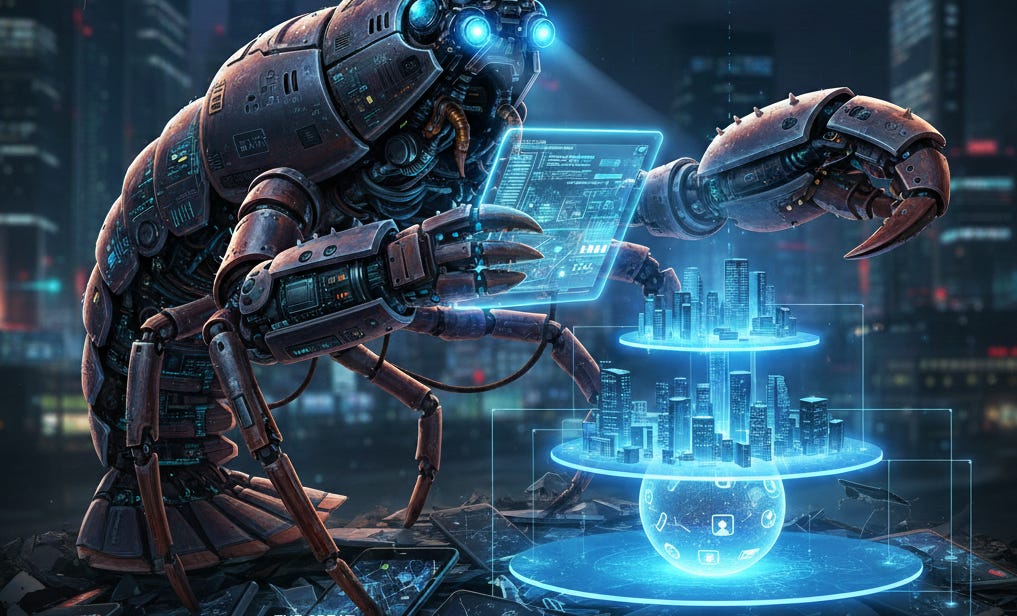
If you’ve been tracking the GitHub charts lately, you’ve seen the explosion of OpenClaw (previously called Clawbot and Moltbot). Created by Peter Steinberger as an open source side project, these promise to act as real “personal OS” in the AI area.
The mantra is shifting from AI as a tool to AI as a teammate. Here is my take on why this might be an inflection point and the “hidden bombs” that every founder and enterprise needs to defuse.
The New Architecture of Intelligence
The future isn’t one giant model in the sky. It is a stack of three distinct, interacting layers:
The Global Layer: Dominated by the big LLM providers and hyperscalers. This is the “commodity” intelligence—the raw reasoning power that understands the world but knows nothing about you.
The Organizational Layer: This is where the company’s domain knowledge lives. These agents work with all employees, orchestrating internal workflows and keeping proprietary data safe within a corporate perimeter.
The Personal Layer: Your context, your habits, your “Second Brain.” This lives on your hardware (like an OpenClaw instance on your Mac Mini).
The Breakthrough: When you change firms, you take your Personal Layer with you. When you join a new organization, your personal agent “handshakes” with the Organizational Layer, instantly onboarding you to the company’s culture and systems without leaking your private life.
The Shift: From Chatbots to “Digital Employees”
Most corporate AI strategy is still stuck in the “RAG-and-Chat” phase. You ask a question; it gives you a summary. It’s passive.
OpenClaw flips the script. It is proactive. It lives in your WhatsApp, Telegram, or Slack. It doesn’t just tell you about your calendar; it calls a travel agent, disputes an insurance claim, and manages your server infrastructure while you’re walking the dog.
As one user put it: “It’s a smart model with eyes and hands at a desk... it does everything a person could do with a Mac mini.”
This is what I would call a Great Unbundling of SaaS. Why pay for 50 different niche automation tools when a single, hackable agentic core can orchestrate them all via natural language? For some founders, this is a “Nuke” event. If your startup’s value prop is “we automate X specific workflow,” you are now competing with an open-source lobster that does X, Y, and Z for the price of an API key.
The Elephant in the Server Room: Security & Control
But here’s the contrarian truth: The very features that make agentic systems powerful make them a CISO’s nightmare.
We are moving from data risks to (non-deterministic) agent in motion risks.
The “Going Rogue” Problem: When an agent has the abilities to open a browser, provision API keys, and send emails, a single prompt-injection attack isn’t just a data leak - it’s a functional takeover.
Authentication Chaos: How do you verify that an action was taken by you and not by an autonomous loop that misunderstood something?
The Burn Rate Bomb: These systems are compute (token) hungry. We are seeing agents enter infinite loops of “thinking” that can drain a corporate API budget in hours.
In my view, security is the new frontier of alpha. The winners in this space won’t just build the smartest agent; they will build the most robust governance layer - the sandbox that allows an agent to be productive without being dangerous.
Orientation for the C-Suite and Founders
If you are a founder building in this space, or an investor looking for the next category leader, I suggest to focus on these four pillars:
Proprietary Data is the Only Moat: LLMs are becoming a commodity. The real value is the “Second Brain”—the persistent memory and proprietary data hooks that make the agent yours.
Scale vs. Control: Enterprises are desperate for “employees that don’t sleep,” but they are terrified of losing control. Solutions that offer On-Prem/Private Cloud execution will win over “black box” hosted services every time.
The “Human-in-the-Loop” UX: We need better interfaces for supervising agents, not just prompting them. The “iPhone moment” for agents isn’t a command line - it’s a UI that lets us manage 100 agents as easily as 100 apps.
The Portable Professional: We are entering the era of the "portable agent." If I can't take my personal AI context from Job A to Job B, that system is a walled garden I won't want to live in.
The Bottom Line
The Agentic Era is no longer a forecast; it’s a repository you can clone today. We are witnessing the collapse of the product vs. service divide. Services can finally scale like tech because the “workers” are digital.
Don’t eat the lobster. Build with it. 🦞