

Venture capital is currently throwing billions of dollars into a deep-tech phenomenon that makes no economic sense: the push to put humanoid robots into warehouses and factories.
We are treating science fiction as a roadmap for industrial automation. It's a massive misallocation of capital driven by what can only be described as a "God Complex". Our deep-seated, psychological obsession with creating machines in our own image. We are so fixed on passing a physical "Turing Test" that we forget a machine doesn't need a face, shoulders, or hips to be a world-class manufacturing asset. It needs a purpose-built architecture.
If we strip away the marketing hype and apply raw unit economics, the humanoid thesis falls apart.
The Silicon-Biology Mismatch
True human versatility comes from a massive, highly parallel, self-healing organic brain and muscular tissue. Our current hardware and software architectures share absolutely zero characteristics with human neurology and biology. Forcing rigid electric actuators and binary code into a human silhouette doesn't inherit human capability; it just inherits our structural vulnerabilities.
Furthermore, human biology is a masterpiece of thermodynamic efficiency. A human being can walk, think, lift, and self-repair while running on roughly 100 watts of power, the equivalent of a light bulb. Today's humanoid prototypes pull thousands of watts just to stay upright and move at a casual walk.
Form vs. Function: The Reality of Controlled Environments
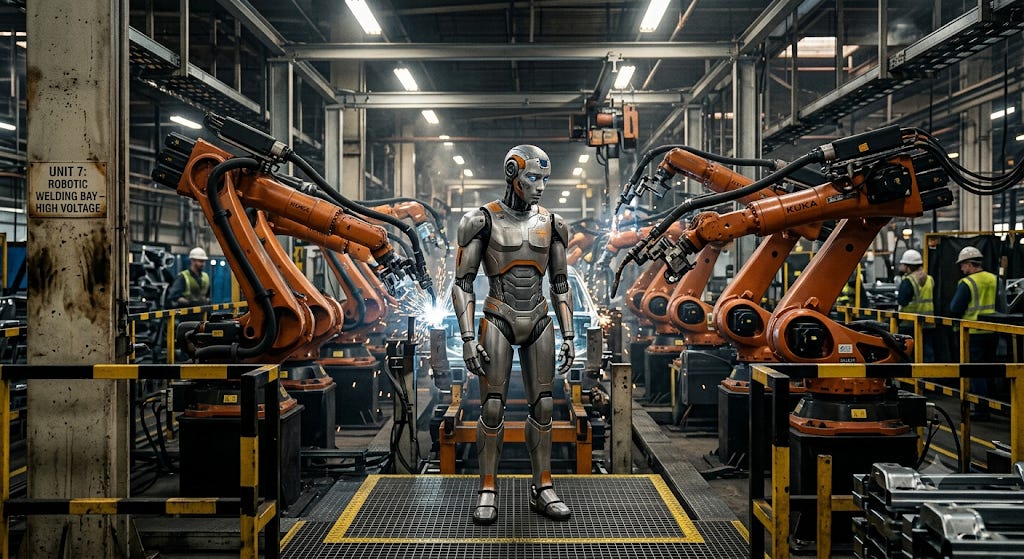
Humanoid forms make sense if a robot needs to live in an environment designed exclusively for human biological constraints, like human homes or eldercare facilities. But deploying a two-legged robot on a modern warehouse or factory floor misses the point of industrial optimization.
Today autonomous systems operate successfully within highly controlled environments. The moment a machine encounters an edge case outside its training data, such as an unpredicted obstacle or an active human worker on site, the risk of operational drift, safety hazards, and mechanical failure increases exponentially.
Why are we trying to solve for the most chaotic, complex environments when optimizing for simpler, controlled ones yields superior results?
Legged locomotion is a biological workaround, not an engineering ideal. Nature couldn't easily grow wheels with blood vessels, bones and nervous systems. In a controlled industrial environment with flat floors, wheels are more stable, faster, and mechanically simpler than a pair of carbon-fiber legs trying to solve multi-axis balancing equations every millisecond.
The Teleoperation Trap vs. True Autonomy
Perhaps the most unspoken reality of the current humanoid race is the hidden operational model: teleoperation. Many of the viral video demos showcasing humanoids executing complex tasks are actually being remote-controlled by human operators wearing VR headsets and haptic suits.
This brings us to a fundamental question of scalability: Do we want autonomous robots, or do we want a human operator per robot?
If a million-euro humanoid machine requires a dedicated, full-time human operator behind the scenes just to navigate a dynamic factory floor, it is not an automation solution, it is an expensive avatar. True industrial scaling relies on an inverted ratio: one operator managing a fleet of twenty fully autonomous, purpose-built systems. Forcing a machine to operate via real-time human mirroring defeats the core economic driver of robotics, turning a tool for operational leverage into a high-tech bottleneck.
Actionable Insight for Builders and Investors
As investors and entrepreneurs, our job is to separate cultural daydreaming from unit economics. When evaluating a robotics venture, I look for architectural pragmatism, not anthropic vanity:
Prioritise Purpose-Built over Versatile: General-purpose humanoids try to do everything poorly at a price premium. Purpose-built robotics do one thing great with a clear ROI.
Evaluate the Environment, Not Just the Machine: If the environment can be subtly modified to accommodate a simpler or wheeled system, that solution will always beat a complex humanoid on maintenance cost, safety and uptime.
Watch the Watt Hour Per Task: True scaling depends on energy consumption. I talked about intelligence per watt previously. In robotics I would look for a power-to-payload ratio.
We don’t need robots that look like us to build the future. We need robots that think and move with the efficiency of engineering.