

We’ve spent the last decade convinced that “software is eating the world.” We built an entire venture ecosystem on the premise that capital is the only finite resource and code is infinitely scalable.
But here’s the hard truth: Software is starving the world of its physical foundations.
For years, we treated the supply chain as a “frictionless medium” - a line item for the COGS department, not the Board. We assumed that as long as we had a credit card and an AWS account, the “intelligence” would flow. It is not that simple.
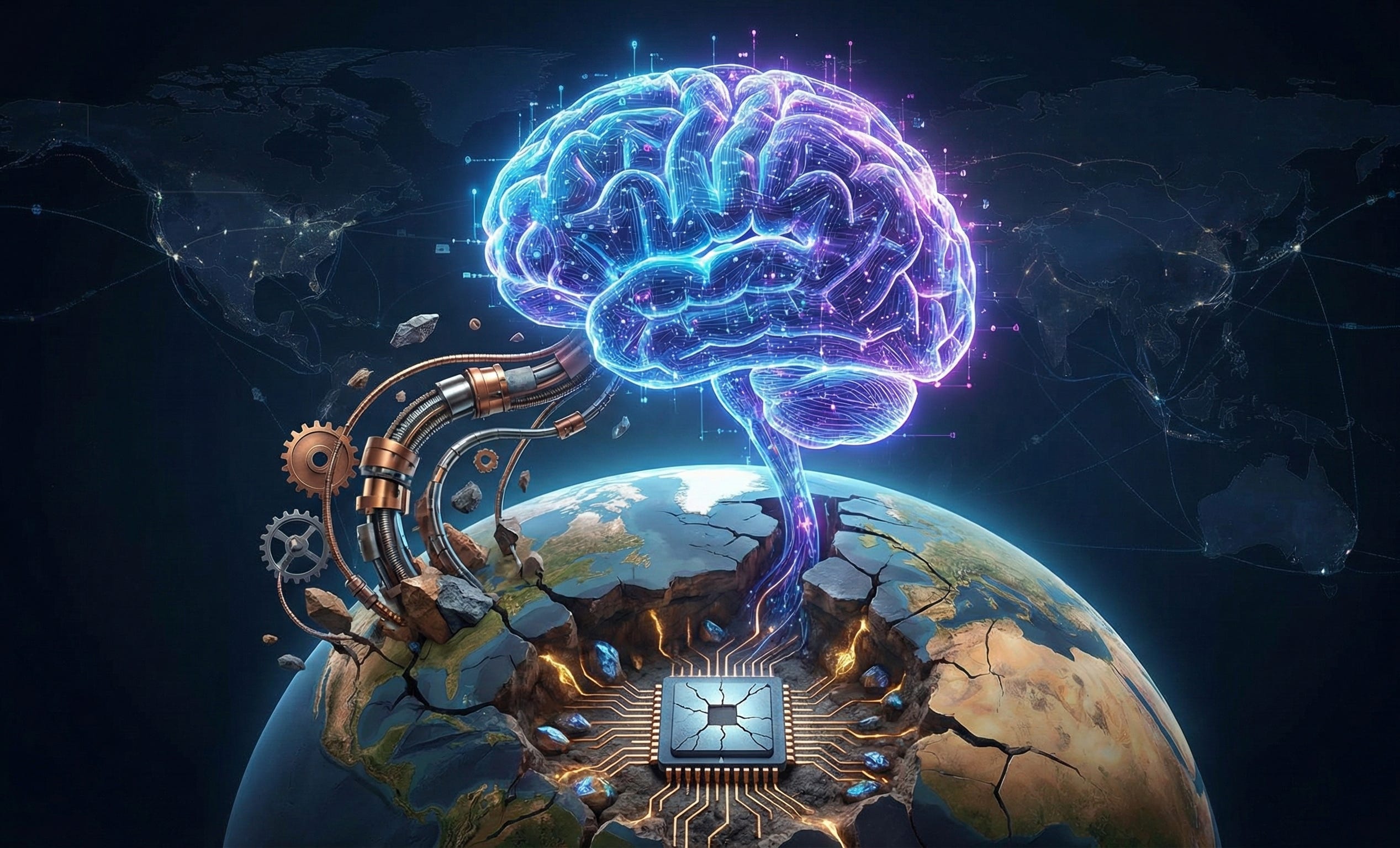
The Illusion of the Weightless Economy
As Sarah Spiekermann warned back in 2023, the “Zenit of digital transformation” may be hitting a physical wall. We are currently witnessing the end of the “Neutral Supply Chain.” The “just-in-time” philosophy that powered the Silicon Valley boom relied on a geopolitical stability that no longer exists.
If you are an investor or a founder today, you aren’t just in the business of AI; you are also in the business of geopolitical arbitrage and mineral security.
The Numbers That Should Keep You Up at Night
The complexity of the modern chip - the foundational unit of our “weightless” economy - is staggering. To produce a single high-end chip, we rely on:
300+ materials, 100+ gases, and 500+ specialized chemicals.
92% of high-performance chips (and around 60% of all chips) coming from one place: Taiwan.
94% of the world’s Gallium and 84% of Germanium controlled by China.
We talk about “moats” in software, but the only moat that matters right now is the one surrounding Taiwan, and the mineral deposits under the ice in Greenland. When the price of high-purity Neon (50-70% of which used to come from Ukraine) spikes this could impact everyone done the line.
From “Hot Potato” to “Hard Assets”
I’ve written before about the “Hot Potato” game in VC - passing overvalued AI startups from one fund to the next, hoping the timer doesn’t hit zero on your watch. But the real timer isn’t just valuation; it’s the physical burn rate.
The energy and material demands of AI are astronomical. As we push for more “intelligence per watt,” we are increasingly dependent on rare earth elements (REEs) that take 10 to 15 years to bring from a discovered mine to a stable supply. There is no “agile” or “pivot” for a physical shortage.
If your “defensible” software or AI application relies on a supply chain where the material substitution cycle is 2 to 15 years, you don’t have a moat - you have a trap.
The Investor’s New Mandate: Commodity Intelligence
In the late-2020s, the most valuable tool in an investor arsenal might not be a spreadsheet but Commodity Intelligence. We are seeing a renaissance where the “dirt” (or atoms) matters as much as the “data.”
Silicon Provenance: Founders must be able to articulate their supply chain depth. If your hardware partner is one “export control” away from bankruptcy, you are at risk too.
The Greenland Hedge: As the U.S. and China decouple, unconventional geographies (like Greenland for REEs) become the new strategic frontiers.
Efficiency as Alpha: We should stop funding “more compute” and start funding “more output per watt.” Resilience is the new scale.
“In the era of great power competition, a line of code is only as strong as the molecule of Gallium that powers it.”
The Bottom Line
We’ve had it easy. For thirty years, we ignored the “lithography of geopolitics.” But as the digital world hits a physical braking distance, the winners won’t be those with the most capital, but those who understand the physicality of the cloud.
Founders: How many layers deep does your supply chain knowledge go?
Investors: Are you investing in the “next GPT,” or are you investing in the infrastructure that ensures the lights stay on when the “just-in-time” world breaks?
Let’s start building for a world where the physical foundations are no longer guaranteed.