

In the high-energy world of tech innovation, a successful funding round is often celebrated with the same intensity as a championship win. Just think about the recent mega-seed rounds of AMI ($1b) that completely distort the usual perception. However, seasoned practitioner views capital through a more disciplined lens: aside for funds to bring new things into existence (pre-seed, seed getting form 0 to 1), fundraising is a powerful tool designed to fuel a proven engine, but it is also a strategic responsibility that permanently reshapes your company’s path.
By understanding the mechanics of alignment and the nuance of deal terms, founders can ensure that outside capital acts as a catalyst for growth rather than a burden on autonomy.
The Power of Capital: Fertilizer for Growth
Think of venture capital as high-grade fertilizer. When applied to a healthy, validated business model, it has the remarkable ability to supercharge growth and overcome engineering or sales bottlenecks.
The challenge lies in the timing:
The Scaling Opportunity: Raising capital to scale a proven model allows you to capture market share at a pace that is otherwise impossible.
The Trap of Premature Capital: Infusing capital into an unproven concept can act as a toxin, magnifying existing problems and erratic strategic pivots.
Rare discipline in prioritizing control over velocity can lead to massive exits, where founders retain the vast majority of the upside.
Alignment: Choosing Your Boardroom Partners
Securing an investor is maybe your most critical hiring decision. You aren’t just gaining a bank balance; you are inviting a sparring partner into your boardroom to provide another perspective, while you manage and scale the daily business.
The Goal of Negotiation is Not Competition, but Alignment. True alignment means moving beyond the “vanity trap” of the highest valuation to find a partner who values fairness over leverage. A lower valuation with “clean” terms is often superior to a high valuation burdened by restrictive clauses.
Strategic Hazards to Navigate:
The Subsidiary Trap: Taking investment from a single Corporate VC (CVC) can inadvertently block competitors from becoming customers.
Cap Table Integrity: Be wary of investors who suggest diluting early supporters as a condition of entry, as this signaling can destroy trust within the boardroom.
When Structure Outweighs Valuation
A headline price is only half the story; the preference stack determines who actually gets paid when the company sells. Liquidation preferences serve as “downside protection” for investors, but they can significantly shift proceeds away from founders.
Consider an exit scenario where an investor put in €5M for a 20% stake:
1x Non-Participating (Standard): The investor chooses the higher of their €5M preference or their pro-rata share. In a €10M exit, they take €5M and the founders keep €5M.
1x Participating (Aggressive): The investor takes their €5M back first, then participates in 20% of the remaining €5M. They walk away with €6M, leaving the founders with only €4M.
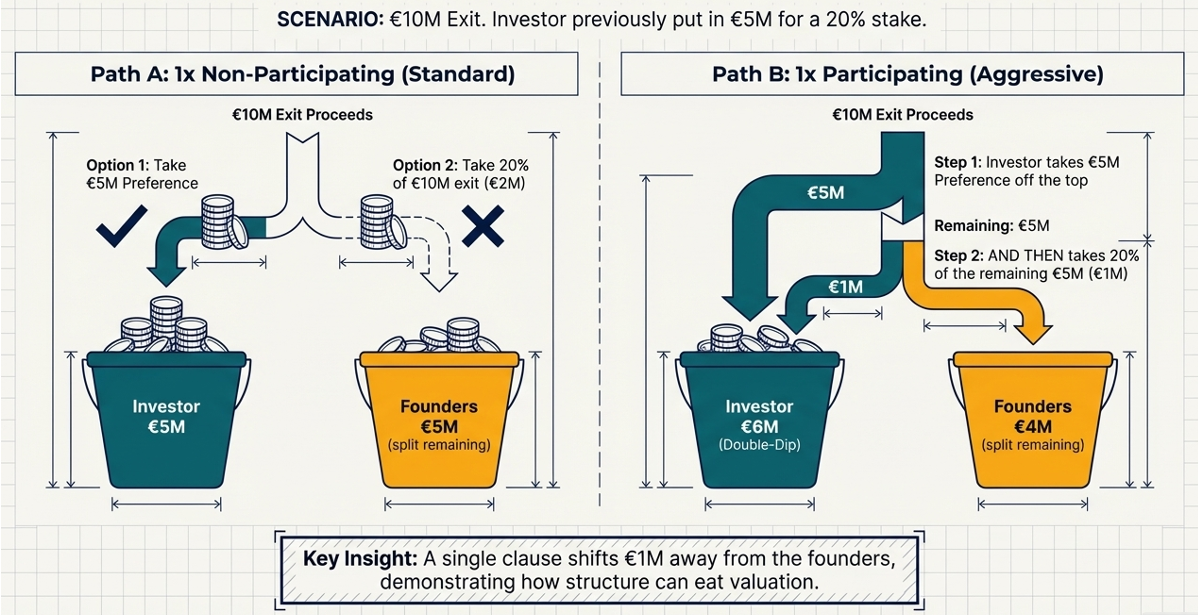
This “double-dip” mechanism illustrates how a single clause can shift millions in value, proving that the structure of a deal is often more impactful than the valuation itself.
The Anchor of Resilience
Fundraising is a demanding cycle of validation and rejection. Resilience in this context is the ability to filter external noise and remain committed to your core understanding of the problem you are solving.
A signed term sheet is merely “qualifying for the Olympics”; the deal is never truly done until the money is in the bank. Maintaining clean documentation and a high-growth mindset ensures that when you do take on capital, it serves your company’s mission - not the other way around.